Published Sep 9, 2026 · 11 min read · Multigenerational Workforce
TL;DR
The premise is aimed at the wrong generation. In Singapore, Deloitte’s 2026 survey found Gen Z’s top career goal is financial independence at 26%, while it’s millennials who put work-life balance first at 31%. Globally, Gen Z are less likely than millennials to call work-life balance a barrier to leadership (41% vs 46%). What looks like a values problem is mostly an economics one.
In This Article
- Is Gen Z Really More Focused on Work-Life Balance Than Everyone Else?
- What Gen Z Is Actually Asking For
- Why Does Every Generation Think the Next One Is Soft?
- So Is Prioritising Work-Life Balance Bad for Gen Z’s Careers?
- The Most Boundaried Generation Is Also the Most Stressed
- What Should Managers Actually Do About It?
- Frequently Asked Questions
You send the message at 8:14pm. Nothing urgent, really. Just a thought you had on the MRT home that you wanted to get out of your head before you forgot it.
The reply lands at 9:03 the next morning.
And something about that gap bothers you more than it should. You’re not angry. You wouldn’t put it in a performance review. But it sits there, and by Thursday it has quietly hardened into a sentence you say to a colleague over lunch: “This generation just doesn’t want to work.”
I’ve spent years training companies across Asia on managing multigenerational teams, and that sentence, in one form or another, comes up in almost every room. So let’s actually test it. Because the data on Gen Z and work-life balance says something considerably more interesting than either side of this argument usually admits, and the honest answer to “is it a bad thing” turns out to be yes and no, in specific ways you can do something about.
Is Gen Z Really More Focused on Work-Life Balance Than Everyone Else?
In Singapore, no. Deloitte’s 2026 Gen Z and Millennial Survey found that Gen Z’s single biggest career goal is financial independence, cited by 26% of them, while the generation that ranks work-life balance first is millennials, at 31% (Deloitte Southeast Asia, 2026).
Read that again, because it reverses the usual complaint. The colleague in your leadership meeting who rolls their eyes about Gen Z and their boundaries is, statistically, more likely to be describing the person sitting next to them than the 24-year-old in the corner.
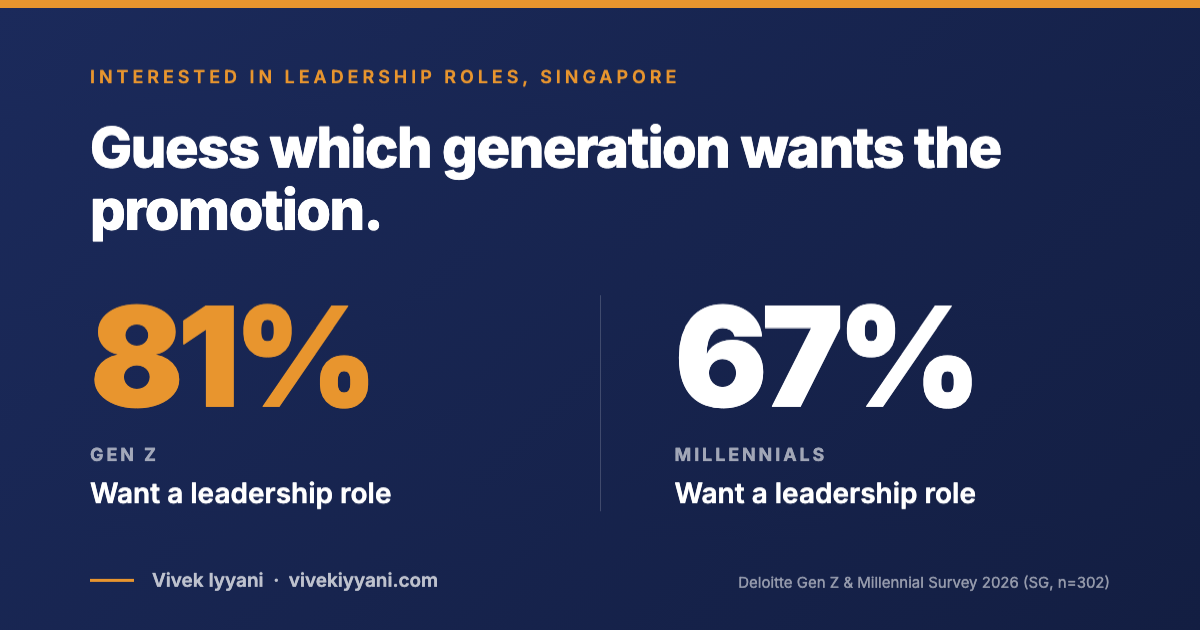
It gets less flattering to the stereotype. In that same Singapore sample, 81% of Gen Z said they were interested in leadership roles, against 67% of millennials. And globally, when Deloitte asked what puts people off senior leadership, Gen Z cited work-life balance concerns less often than millennials did, 41% against 46% (Deloitte Global, 2026).
Worth being straight about the numbers: the Singapore sample is 302 people out of a global 22,595 across 44 countries, with fieldwork between 24 November 2025 and 15 January 2026. Three hundred people is a small base and I wouldn’t hang a strategy on a two-point difference. But this isn’t a two-point difference. An 81-to-67 gap on leadership ambition, running in the opposite direction to the stereotype, is not noise.
So where did the stereotype come from? Partly from the fact that Gen Z say the quiet part out loud. Millennials wanted balance too. They mostly negotiated for it privately, or burned out and left, or got it years later once they had enough standing to ask without it costing them. Gen Z asks in week three. Same want. Different volume.
What Gen Z Is Actually Asking For
They’re asking for a different price, not a smaller job. The clearest evidence is what they say about money and housing. Globally, 69% of Gen Z say housing costs affect their career decisions, and 55% have delayed a major life decision because of their finances (Deloitte Global, 2026). In Singapore, cost of living was the top concern for 49% of them.
Put those next to the leadership numbers and a coherent picture appears. This is a group that wants to get ahead, is worried about money, and still declines the thing you’re offering. That combination only makes sense if they’ve decided the offer is bad.
Think about what the old bargain actually was. You gave your twenties away. Long hours, no complaints, whatever the boss needed on a Saturday. In exchange you got a flat, a title, and the reasonable expectation that by your late thirties you’d be the one sending the 8pm messages instead of answering them. It wasn’t a fair deal exactly, but it was a real one. The payoff arrived.
Gen Z watched that payoff stop arriving on schedule. They watched people who did everything right get restructured anyway. And they’ve drawn a conclusion that’s actually quite rational: if the reward is uncertain, stop prepaying for it in full.
Notice they haven’t swung to the opposite extreme either. In Singapore, 46% of Gen Z said they want steady progress in their careers, against just 25% who want fast-paced growth. A generation demanding everything immediately doesn’t answer a survey that way. They’re asking for something believable, on a timeline they can plan around.
And 94% of them said purpose matters to their job satisfaction. They’ll give you a great deal. They want to know what they’re getting.
Why Does Every Generation Think the Next One Is Soft?
Because boundaries always look like weakness right up until they become policy. Singapore has an unusually clean example of this, and most leaders here lived through it.
On 1 September 2004, the Singapore civil service moved to a five-day work week. The stated reason, in the government’s own words at the time, was “to enable civil servants to strike a better work-life balance” (Ministry of Foreign Affairs, 2004). Before that, Saturday mornings were simply part of the week.
Ask anyone who was in the workforce in 2004 what the reaction was in some quarters. Standards were slipping. The young ones didn’t know what real work looked like. The country would lose its edge.
Twenty-two years later, nobody in Singapore describes a five-day week as soft. It’s just Tuesday. The people who benefited most from that change are, by and large, the people sitting in the leadership seats today, and quite a few of them are the ones now saying this generation doesn’t want to work.
The pattern keeps running. Since 1 December 2024, employers in Singapore have been required to fairly consider formal flexible work arrangement requests under the Tripartite Guidelines (Ministry of Manpower). Five years ago that would have been called an entitlement. Now it’s a compliance item with a two-month response window.
This is the thing to sit with before your next conversation about Gen Z and boundaries. Today’s entitlement has a strong historical tendency to become tomorrow’s HR policy, and the generation that pushed for it usually gets remembered as reasonable, once everyone else has quietly started enjoying it.
Not sure whether it’s a generational issue or a management one? That distinction is usually where the real problem lives, and it’s most of what I work on with leadership teams. If you want to think it through out loud, book a free consultation.
So Is Prioritising Work-Life Balance Bad for Gen Z’s Careers?
Not inherently. But two specific versions of it are genuinely expensive, and pretending otherwise would be doing your Gen Z team members no favours at all.
The first cost is visibility. The most careful research we have on this is an experiment run by economists at Stanford with a large Chinese travel company, published in the Quarterly Journal of Economics. Employees who worked from home performed 13% better and quit at half the rate of their office-based colleagues. Their promotion rate was almost 50% lower (Bloom, Liang, Roberts & Ying, 2015).
Two caveats before anyone builds a return-to-office mandate out of that sentence. It was a call centre, and the fieldwork ran in 2010 and 2011, before hybrid work was normal and before any manager had tools for evaluating people they couldn’t see. The size of that gap in a Singapore office in 2026 is probably smaller.
But the mechanism hasn’t gone anywhere. When a manager decides who’s ready for more, they reach for who comes to mind. Presence feeds that. So an employee who is genuinely excellent and genuinely invisible can end up with a career that moves slower than their work deserves, and they’ll usually conclude the system is rigged rather than that nobody could see them.
The second cost is the stuff you only learn by being around. How a deal actually gets closed. Why that client goes quiet in November. Which meetings matter. None of it is in the onboarding deck, because nobody has ever successfully written it down. It transfers through proximity and accident, and a career built on tight boundaries in the first three years can miss a lot of it.
Neither of these is an argument against boundaries. They’re an argument against a specific kind of boundary: the kind you set silently and then never revisit. That version costs you. The version where you’re explicit about what you’re protecting and why, and visible about what you’re producing, costs you very little.
The Most Boundaried Generation Is Also the Most Stressed
Because a boundary on your calendar isn’t the same as recovery in your nervous system. This is the part of the picture that should stop anyone from reading this article as a straight defence.
Globally, 50% of Gen Z named stress and burnout as a reason they’re wary of stepping into leadership, the joint-highest barrier in Deloitte’s data. And 58% reported experiencing digital overload (Deloitte Global, 2026).
A quick word on the burnout statistics you’ll see quoted elsewhere. Depending on which report you pick up, Gen Z burnout runs at 51%, or 74%, or 80%, or 83%, or 98%. Those studies come mostly from companies selling wellbeing software, using definitions of burnout that don’t match each other. I’m not going to quote you one and pretend it settles anything. What I’ll say is that every credible source points the same direction on severity, even though none of them agree on the number.
Here’s the uncomfortable bit for the boundary-setting case. You can leave the office at six, decline every weekend request, protect your annual leave properly, and still be exhausted, because the recovery time got spent on a screen delivering a low-grade drip of comparison and outrage. Protecting hours does very little if the protected hours aren’t restorative.
Which means the manager response of “fine, we’ll respect your boundaries and never mention it again” is not the win it sounds like. It solves the visible problem and leaves the actual one running. If someone on your team is guarding their time carefully and still looks flattened by Wednesday, the hours aren’t the issue.
What Should Managers Actually Do About It?
Stop treating boundaries as a negotiation to win and start treating them as information about what’s broken. Five things that work, all of which you can start this week:
1. Sort urgent from habitual before you hit send at 8pm. Most after-hours messages aren’t urgent. They’re a manager clearing their own head. That’s a legitimate thing to need, so schedule the send for the morning, or write “no reply needed tonight” in the first line. It costs you four seconds and removes the single most common flashpoint I hear about in workshops.
2. Put a date on the payoff. The bargain broke because the reward stopped arriving, so vague reassurance now reads as a warning sign. “Your time will come” lands badly. “Here’s what this project gets you, here’s when we review it, here’s what would have to be true” lands completely differently, because it’s checkable. If you can’t say what the extra effort buys, you’ve found the real problem, and it isn’t generational.
3. Make contribution visible without making presence mandatory. This is the Bloom finding, handled deliberately. If your promotion instincts run on who springs to mind, build something that corrects for it: a running record of what each person actually shipped, reviewed before calibration rather than during it. Then tell your quieter people the mechanism exists. Half the value is in them knowing they don’t have to perform visibility to get credit.
4. Ask what recovery actually looks like for them. Not “are you taking your leave.” Try “what do you do that genuinely resets you, and are you getting any of it?” You’ll sometimes find someone protecting their evenings ferociously and spending every one of them doomscrolling. That’s a conversation worth having, and you can only have it if you’ve already established you’re not fishing for more hours.
5. Audit what your own calendar teaches. Your team learns the real rules from watching you, not from the values slide. If you say you protect weekends and send Sunday emails, they’ve learned that boundaries are for junior people. Whatever you actually do on a Sunday is your policy.
None of this requires a new engagement platform, and none of it requires you to lower a standard. It requires being specific about the deal, which is the thing the old bargain never had to be, because everyone already believed it.
Conclusion
- The stereotype is pointed at the wrong generation. In Singapore, millennials rank work-life balance first (31%). Gen Z rank financial independence first (26%), and 81% of them want leadership roles.
- This is economics, not values. With 69% saying housing shapes their career decisions, refusing to prepay for an uncertain payoff is a rational response to a broken bargain.
- Singapore has been here before. The five-day work week arrived in 2004 to help civil servants “strike a better work-life balance,” and today nobody calls it soft.
- There are two real costs, and they’re worth naming honestly: invisible good work gets promoted more slowly, and tacit knowledge transfers through proximity.
- Boundaries alone don’t fix exhaustion. Protected hours spent on a screen aren’t recovery, which is why the most boundaried generation is also among the most stressed.
So try a simpler question than the one your leadership meeting keeps asking. Is the deal you’re offering one you’d take today, at their age, with their rent? If the answer is no, you’re not looking at a generational problem.
Frequently Asked Questions
Is Gen Z lazy or entitled about work?
The data doesn’t support it. In Deloitte’s 2026 Singapore sample, 81% of Gen Z expressed interest in leadership roles, compared with 67% of millennials, and 46% said they want steady career progress. What reads as entitlement is usually a request for a clearer link between effort and reward.
Do Gen Z employees actually want to be promoted?
Yes, and more of them than you’d expect. Globally, 76% said they’re interested in reaching senior leadership eventually, though only 6% named it as their primary career goal. They want the destination without the version of the journey they’ve watched damage people.
How do I ask a Gen Z employee to work late without damaging trust?
Be explicit that it’s an exception, say why it’s needed, and say when it ends. Most resistance is to open-ended and unexplained demands rather than to effort itself. If you’re asking every week, the request isn’t the problem, the resourcing is.
Is work-life balance different for Gen Z in Singapore compared to the West?
The direction is similar but the pressure is sharper. Cost of living was the top concern for 49% of Singapore’s Gen Z, and housing costs shape career decisions for 69% globally. In a market with Singapore’s property prices, financial security tends to outrank flexibility when the two compete.
Will accommodating work-life balance hurt my team’s performance?
Not on the available evidence. In the most rigorous study we have, employees working from home performed 13% better and quit at half the rate. The risk isn’t performance, it’s that strong performers become invisible and get promoted more slowly, which is a management problem you can fix.
If your leadership team is stuck in the “this generation doesn’t want to work” conversation and it isn’t going anywhere useful, that’s the conversation I get brought in to change. Book a free consultation and we can look at what’s actually happening on your team. My books on Millennials and Gen Z at work are available here.
Keep Reading
- What Do Gen Z Employees Actually Want from Their Managers?: The expectations behind the requests, and which ones are worth meeting.
- How to Motivate Disengaged Gen Z Employees: What to do when boundaries have already tipped over into quiet withdrawal.
- Why Do Gen Z Employees Quit Without Warning?: The signals that appear months before the resignation email.
- How to Manage Gen Z Employees Who Won’t Come to the Office: The attendance argument, and the more useful one underneath it.
- The Complete Guide to Managing a Multigenerational Workforce: The full picture across all four generations on your team.
About the Author
Vivek Iyyani — 4x Author | Keynote Speaker | Multigenerational Workforce Expert
Vivek Iyyani is a 4x published author and keynote speaker who has trained over 100 companies across Asia on managing multigenerational teams. His books on Gen Z and Millennials in the workplace have been featured across major media in Singapore and the APAC region. He helps leaders build the kind of workplaces where every generation wants to stay and grow.
Sources
- Deloitte Southeast Asia: Gen Zs and millennials in Singapore are redefining career success (2026). Singapore sample n=302.
- Deloitte Global Gen Z and Millennial Survey 2026 (2026). n=22,595 across 44 countries, fieldwork 24 Nov 2025 to 15 Jan 2026.
- Ministry of Foreign Affairs Singapore: Introduction of Five-Day Workweek (31 August 2004).
- Ministry of Manpower: Flexible Work Arrangements. Tripartite Guidelines in effect from 1 December 2024.
- Bloom, Liang, Roberts & Ying, “Does Working from Home Work? Evidence from a Chinese Experiment”, Quarterly Journal of Economics 130(1), 2015.